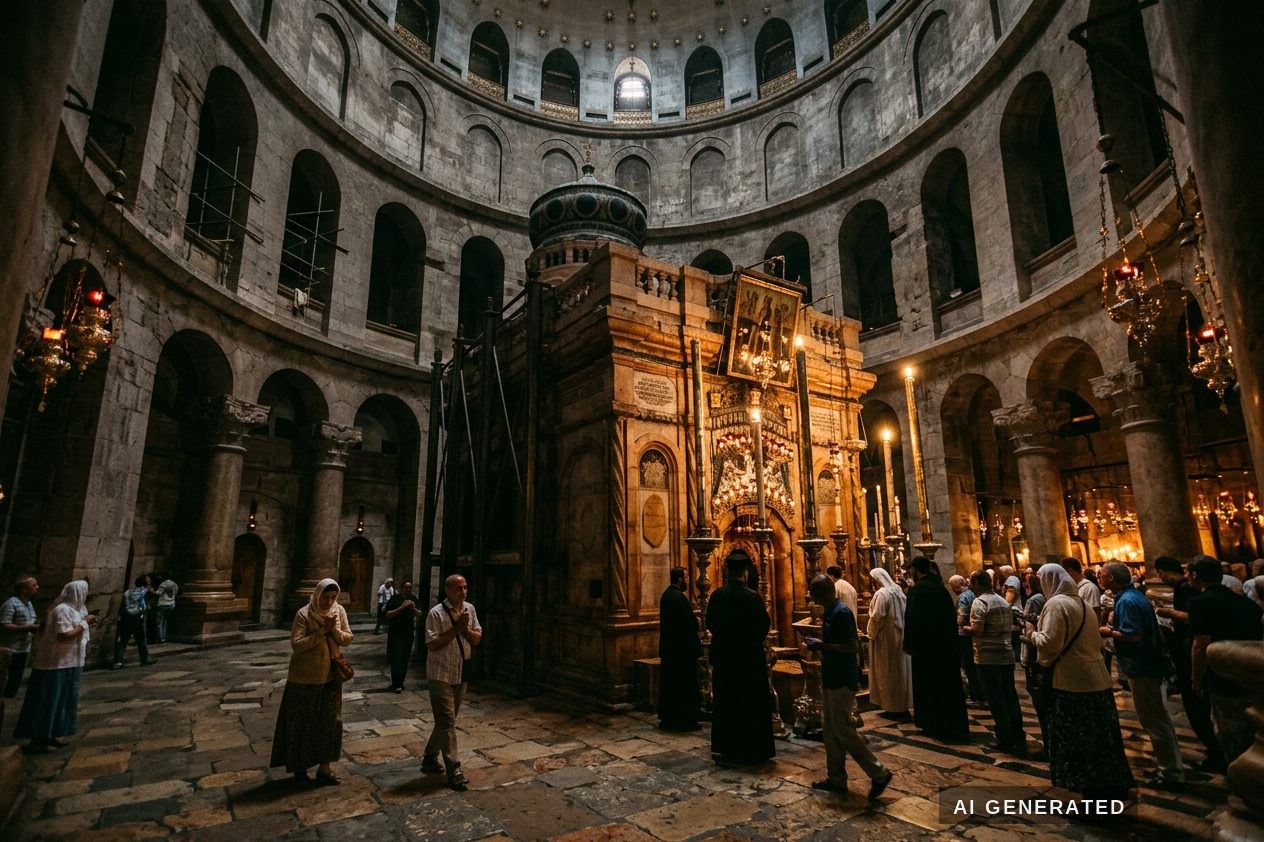
Jerusalem, Israel
Church of the Holy Sepulchre
The church built where Christians believe Jesus was crucified and buried, and where he rose again. Six different churches share the same building.
Biblical significance
This is the most important church in the Christian world. Under one roof it holds the two places that old tradition says are Golgotha, the hill where Jesus was crucified, and the empty tomb where he was buried and rose again. For most pilgrims, this is the place the whole trip to the Holy Land builds up to.
It is also a very odd building. It is dark, crowded and stitched together from bits added over 1,700 years, and six different churches share it — Orthodox, Catholic, Armenian, Coptic, Syriac and Ethiopian. If you know how it grew, the visit makes far more sense than just standing in line for the tomb.
Built over the quarry that Christian tradition, backed by real archaeology, identifies as Golgotha and the garden tomb, the Holy Sepulchre has been destroyed, rebuilt and divided more times than any church on earth. Constantine's builders cut away the hillside in 326 to leave the tomb standing free; the Crusaders enclosed the whole complex under one roof in 1149. Today the Status Quo of 1757 freezes every lamp, step and stone between the Greek Orthodox, Armenian, Latin, Coptic, Syriac and Ethiopian communities. The immovable ladder on the facade has not moved since the eighteenth century.
Scripture
Loading the passage…
Open in YouVersion →Loading the passage…
Open in YouVersion →Loading the passage…
Open in YouVersion →Excerpts from the World English Bible. Full text opens in the YouVersion Bible app.
History
The story of Church of the Holy Sepulchre
A quarry outside the walls
In the first century this ground lay outside Jerusalem's city wall and had been worked as a limestone quarry, later reused for rock-cut tombs. That matches the Gospel description of a crucifixion site outside the city with a nearby new tomb. Excavations under the church have found both quarry face and tomb chambers, which is why most archaeologists treat the location as a serious candidate rather than a late invention.
Constantine's basilica, 326–335
After the Council of Nicaea, Constantine ordered the Roman temple standing on the site removed and a great basilica built over the tomb. Church historians of the period record that the tomb was cut free from the surrounding rock so it stood as a shrine within a rotunda. The tradition that Constantine's mother Helena found the True Cross here belongs to the same generation, but it is church tradition rather than documented archaeology.
Destruction and Crusader rebuilding
The Fatimid caliph al-Hakim had the church largely demolished in 1009, and the tomb itself was badly damaged. What visitors see today is essentially the Crusader church of 1149, which pulled Calvary, the tomb and the surrounding chapels under one Romanesque roof, with later Greek, Armenian and Ottoman-era repairs on top.
The Status Quo
An Ottoman decree of 1757, reaffirmed in 1852, froze the rights of each community to specific chapels, hours and even individual lamps. That agreement is still in force. It explains the famous immovable ladder on the façade, the separate liturgies at different hours, and why the keys have been held by two local Muslim families for generations.
The 2016–2017 restoration
The Edicule — the shrine enclosing the tomb — was structurally restored by a team from the National Technical University of Athens. During the work the burial shelf was uncovered for the first time in centuries, and mortar sampled from it was later dated to the fourth century, consistent with the Constantinian construction. That dates the shrine, not the burial itself.
On the ground
What you can see today
The Stone of Unction
Just inside the door, a slab of reddish stone where pilgrims kneel and press cloths and rosaries. The stone itself dates from 1810; the devotion around it is much older.
Calvary (Golgotha)
A steep, narrow staircase to the right of the entrance climbs to two chapels built over the rock outcrop. Under the Greek Orthodox altar you can reach through a silver disc to touch the bedrock; the exposed rock face is visible behind glass on the way down.
The Rotunda and the Edicule
The heart of the church. The queue for the tomb enters a small antechamber with the Angel's Stone, then a chamber barely large enough for four people at a time, with the burial shelf under marble on the right.
Chapel of St Helena and the quarry
Down a long Armenian-decorated stair with thousands of crosses scratched by medieval pilgrims, then further down again to the rough-cut Chapel of the Finding of the Cross — the clearest place to see the ancient quarry.
The Syriac chapel and rock-cut tombs
Behind the Rotunda, an unrestored chapel opens onto first-century kokhim burial shafts — the strongest visible evidence that this was a working cemetery in Jesus' time.
The visit
What to expect when you arrive
- Time needed
- 1.5–3 hours, longer if you queue for the tomb
- Crowds
- Heaviest 10:00–15:00 and through Holy Week; early morning is calm
- Queue for the Edicule
- Often 40–90 minutes in season, minutes at dawn
- Terrain
- Steep worn stone stairs to Calvary and the crypt; uneven floors
- Accessibility
- Ground floor and Rotunda reachable; Calvary and crypt are stairs only
- Atmosphere
- Dim, incense-heavy, loud with overlapping liturgies
Practicalities
Step by step: how to get there
- 1
Arriving in Jerusalem
Ben Gurion Airport near Tel Aviv is the main gateway, roughly 45–70 minutes away by train to Jerusalem–Yitzhak Navon station, shared sherut taxi or car.
- 2
Reaching the Old City
The light rail stops at City Hall and Damascus Gate, both a short walk from the Christian Quarter. Most visitors enter through Jaffa Gate or New Gate and follow the signposted lanes east.
- 3
The last few minutes on foot
The church has no grand approach — you arrive through covered souk lanes and step suddenly into the courtyard. From Jaffa Gate allow about 10 minutes on foot, from Damascus Gate about 12, both over polished, sometimes slippery stone.
- 4
Walking the Via Dolorosa first
Many pilgrims begin at the Lions' Gate end of the Via Dolorosa and finish inside the church, where the last five Stations of the Cross are located. The Franciscan procession sets out on Friday afternoons.
Checklist
Before you go
- Opening hours are long but change with the season and the liturgical calendar; the doors are opened and locked by the traditional key-holding families.
- Entry is free — there is no ticket and no official guide desk inside.
- Shoulders and knees covered for both men and women; hats off for men inside.
- Bring a small torch or use your phone light for the dark crypt stairs.
- Bags are checked at Old City gates rather than at the church door; travel light.
- There are no toilets inside; use cafés on the way in.
- Shoes with grip — centuries of pilgrims have polished the steps smooth.
- Avoid Orthodox and Catholic Easter unless the crowds are the point of your visit.
Etiquette
Visiting respectfully
- Photography is generally tolerated, but not during services and never inside the tomb chamber when a monk asks you to move on — your time at the shelf is under a minute.
- No flash, and no filming clergy at close range.
- Keep conversation to a whisper; several liturgies may be running at once in different chapels.
- Do not cross ropes or enter chapels marked for a specific community during their hours.
- Let local worshippers and elderly pilgrims move ahead of you in the queue when they ask.
Best time to go
Early morning, before the tour groups arrive; Orthodox Holy Week if you can bear the crowds.
Visitor notes
Free entry. Modest dress required. Queues for the Edicule can exceed two hours at midday — arrive at opening.
Coordinates
31.7784, 35.2298
On the map
Open the world atlasKeep going
Continue the trail
- Via DolorosaJerusalem, IsraelThe processional route that ends at this church's final stations.
- Mount of OlivesJerusalem, IsraelGethsemane and the Palm Sunday descent, twenty minutes east.
- JerusalemJerusalem, IsraelThe wider Old City: quarters, walls and gates around the church.
- Church of the NativityBethlehem, PalestineBethlehem, under an hour south — the nativity counterpart to this site.
Find it on Google Maps
Church of the Holy Sepulchre on the map
Open directionsPlan your pilgrimage
Getting to Church of the Holy Sepulchre
Everything you need to turn this holy place into a journey. We may earn a commission from these partner links, at no extra cost to you.
Share your experience
Have you been here?
Rate this place and share your experience with other Christrails travellers.
Rate This Place
Be the first to rate this place
Visitor Experiences
No visitor experiences yet. Be the first to share yours.
Share this page
Nearby in this category
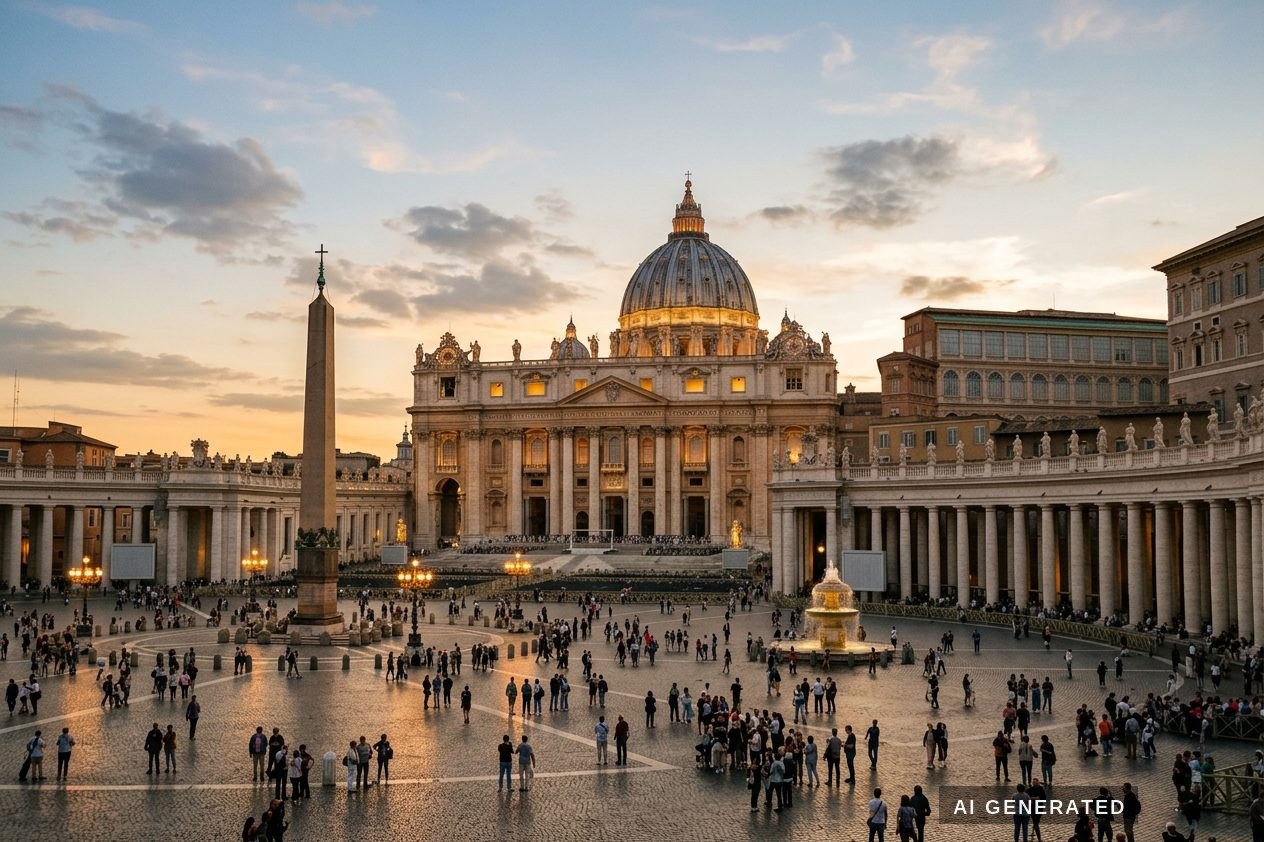 4/5 Significance
Vatican City, Vatican City
St Peter's Basilica
The biggest church ever built, with Michelangelo's dome over the tomb of Peter the fisherman.
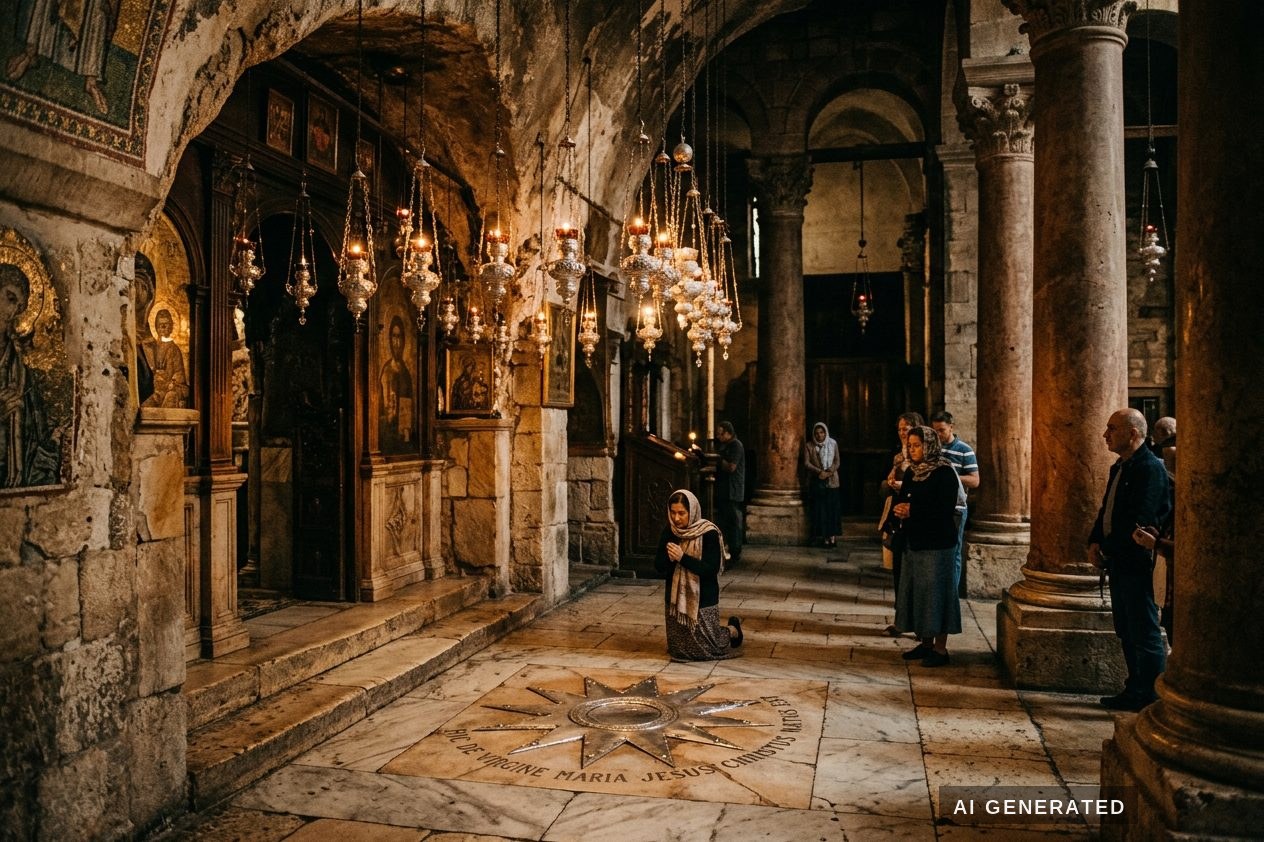 5/5 Significance
Bethlehem, Palestine
Church of the Nativity
The oldest church still used every day. It stands over the cave where Jesus is believed to have been born, marked with a silver star.
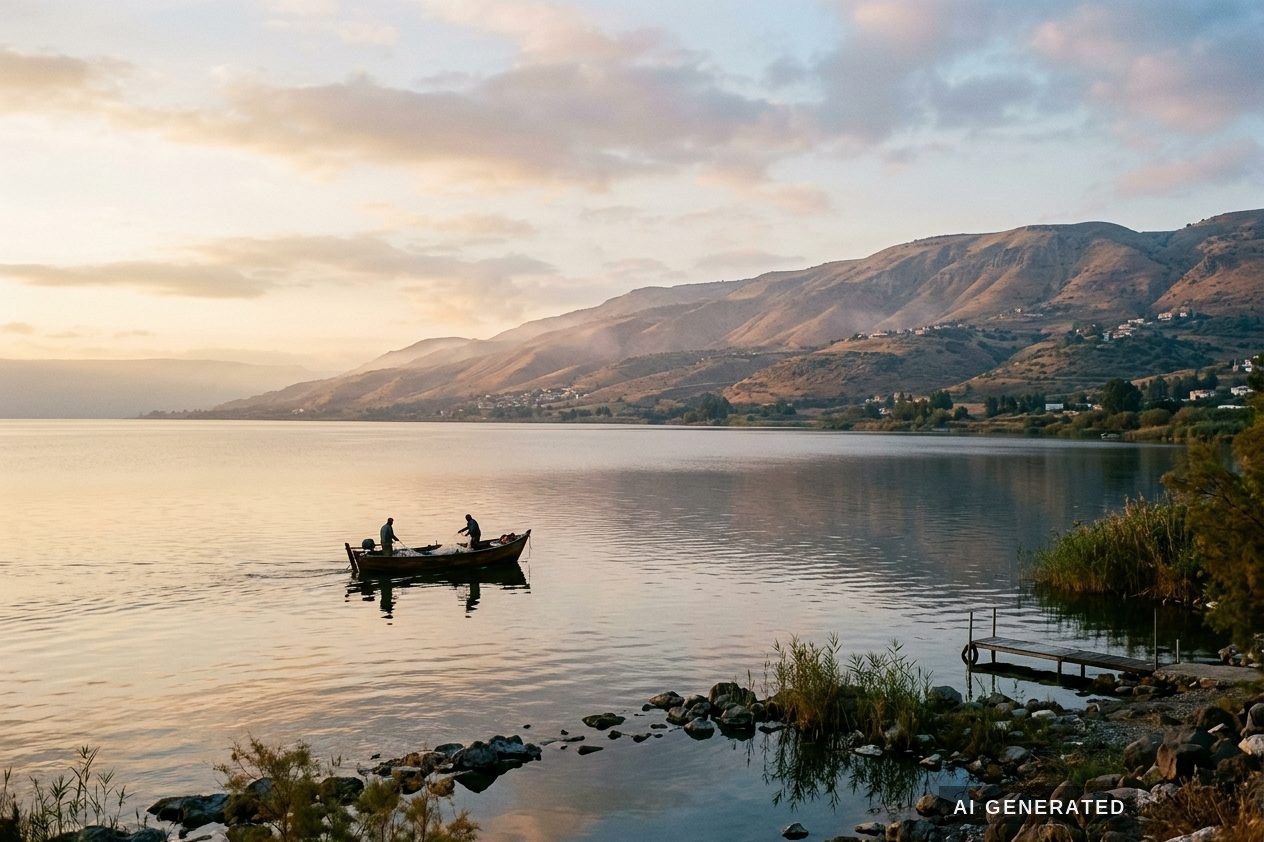 5/5 Significance
Tiberias, Israel
Sea of Galilee
A large freshwater lake, 210 metres below sea level, where Jesus did most of his teaching and healing.